
What do we bring for an emergency response?
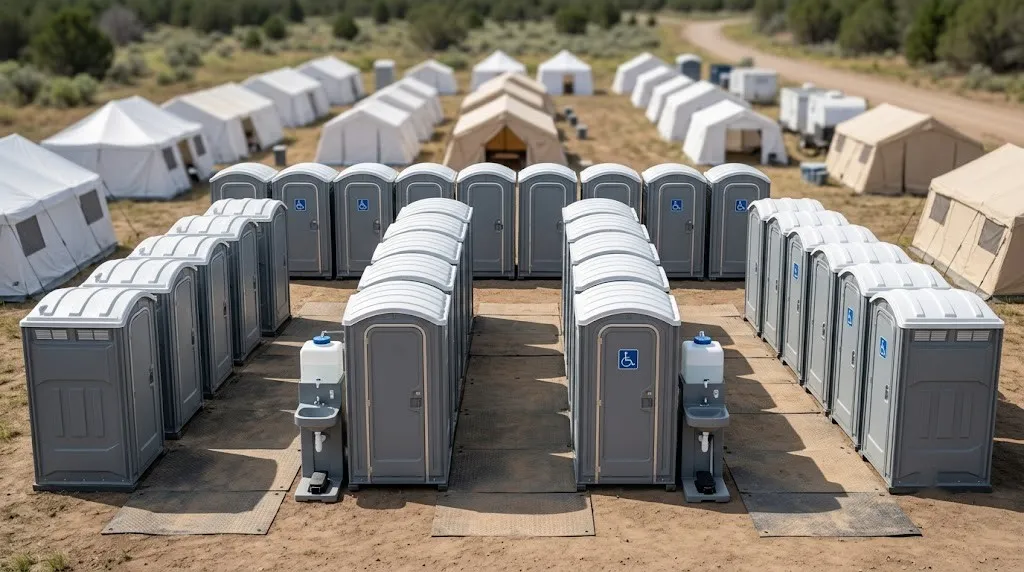
The answer depends on how many people need service and for how long, but the base kit is the same one we use for any disaster staging site: standard portable toilets, a handwashing station rental, and a holding tank rental if the site has no sewer access at all. A standard unit carries a 60 to 70 gallon holding tank and stands about 92 inches tall, so it fits on a trailer pad, a parking lot, or a gravel lot behind a shelter without much site prep. If the response involves displaced households sheltering for more than a couple days, we add a shower trailer rental or a small restroom trailer rental, since flushable units hold up better under heavy, continuous use than standard ones. For agencies managing a large encampment, a 4 stall restroom trailer or an 8 stall restroom trailer covers more people per unit and cuts down on service stops. We also stage temporary fence rental or crowd control barrier rental around staging areas when crowd flow is part of the problem, and a light tower rental or temporary power pole if the grid is down. Every cluster of single-user units we place includes an accessible unit, per ADA Standards section 213.2, which requires at least 5 percent of clustered units, and never fewer than one, to be accessible.
How fast can service start in Walnut Creek?
Response time depends on how far the site sits from our staging point and how many units the order needs, but most standard placements in Walnut Creek move within the same day. We already cover the closer towns on a routine basis: Shell Ridge sits 2.2 miles northeast, San Miguel 2.7 miles south, Pleasant Hill 5.7 miles northwest, and Lafayette 5.8 miles west, so trucks and tanks are rarely far from wherever an incident happens. Danville, at 10.8 miles southeast, adds a little more drive time but still falls within a same-day window for most orders. A roll-off delivery for debris cleanup needs about 60 feet of straight clearance behind the truck, which matters when a disaster site has downed trees, collapsed fencing, or blocked driveways; we check that before we dispatch. Once storm debris starts piling up, a roll-off dumpster rental sized right for the job keeps crews from tracking hazards across the site. See dumpster sizes and dimensions if you are not sure which size fits a damaged property. We also keep storage container rental units on hand for agencies that need to secure donated supplies or equipment on-site, and a mobile office trailer rental works well as a command post when a shelter runs multi-day operations.
Does disaster response follow the same rules as a normal job site?
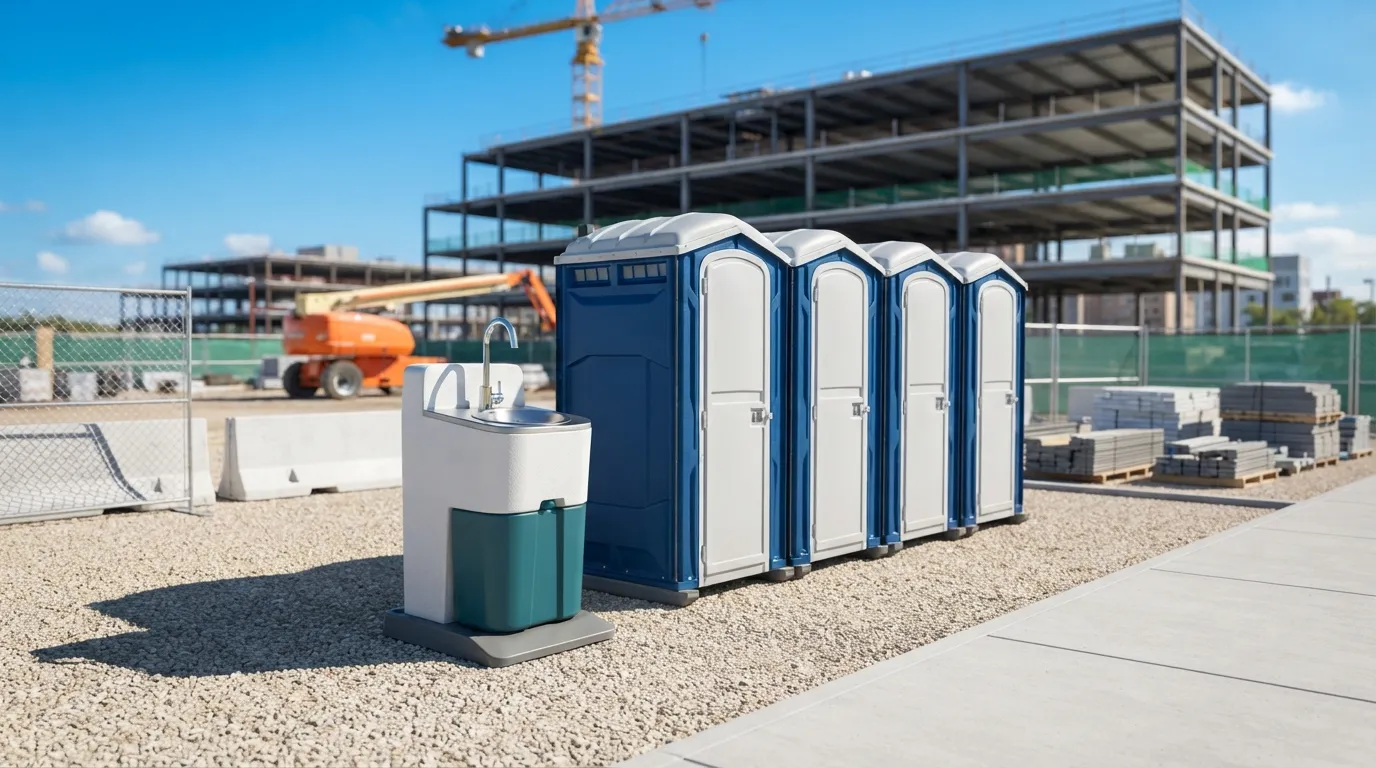
Yes, mostly. OSHA sanitation standards do not pause for an emergency, and neither do ours. Under OSHA 1926.51(c), a site with 20 or fewer workers needs one toilet facility; that ratio climbs to one toilet and one urinal per 40 workers between 20 and 199, and one per 50 workers at 200 or more. Relief workers and volunteers count the same as any other crew. Potable water also has to be on-site under OSHA 1926.51(a)(1), which is why we pair handwashing stations with toilet placements rather than leaving one without the other. If cleanup crews are using coatings, herbicides, or insecticides during restoration work, OSHA 1926.51(f)(1) requires washing facilities specific to that contaminant exposure, not just general handwashing. Under 29 CFR 1910.141(d)(2), any washing station we place needs soap and a way to dry hands; sanitizer alone does not meet that standard, so we do not substitute a hand sanitizer station rental where actual washing is required. For accessible routes through a shelter or staging site, ADA Standards section 403.5.1 sets a 36 inch minimum clear width, which we factor into where units and ramps go. If you are staging a longer-term response and want a fuller breakdown of ratios, our how many porta potties do I need guide walks through it by headcount.
Pricing during an emergency response follows the same bands as any rental, no disaster surcharge beyond standard weekend or rush delivery fees:
| Item | Day | Week | Month |
|---|---|---|---|
| Standard unit | $100-$350 | $130-$500 | $125-$325 |
| ADA unit | $200-$400 | $185-$240 | - |
| Delivery fee | $100-$500 | $100-$150 | $120-$420 |
For agencies planning ahead rather than reacting to an active event, construction site services and emergency porta potty rental cover the planning side, and request a quote gets a real number back fast once we know headcount and duration.
How quickly can you deliver during an active emergency?
Most standard unit orders in Walnut Creek move same-day, sometimes within a few hours if trucks are already routed nearby. Trailer and holding tank orders usually need 24 to 48 hours. Call Walnut Creek Porta Pros directly rather than submitting a web form when time is critical.
Do you work directly with shelters and emergency management agencies?
Yes. We coordinate with shelter operators and response coordinators on unit counts, placement, and servicing schedules, and we can invoice the agency directly rather than requiring payment at delivery for verified relief operations.
What if the site has no power or water at all?
That is normal for disaster staging. Standard units and holding tanks need neither. Handwashing stations bring their own water reservoir, and light towers run on their own generators, so a fully dark site is not a barrier to service.
Can you service a site with debris or damaged access roads?
Often, yes, but a roll-off truck needs roughly 60 feet of clear straight approach behind it. If access is blocked, tell us during the call; we will route a smaller vehicle or ask crews to clear a path first.
How often do units get serviced during a multi-day response?
Standard servicing follows the ANSI/PSAI Z4.3 baseline of one visit per week for moderate use, but active shelters and crews on-site full time usually need more frequent pumping. We set the schedule once we know population and hours of use.
Next step
Get a delivery date
Tell us the address, the dates and the headcount. We size the order and confirm the route.