
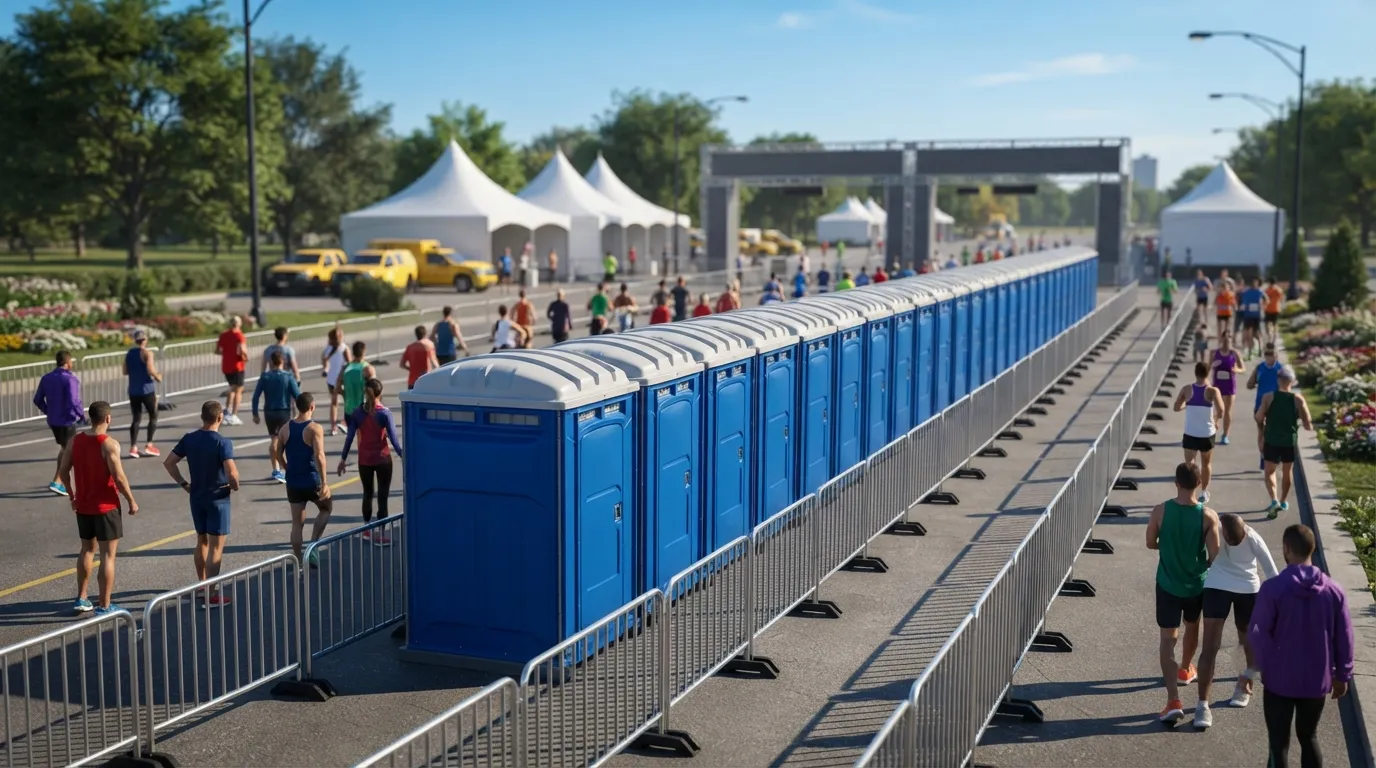
How many restrooms does a race need?
Start with the crowd, not a guess. OSHA 1926.51(c) sets construction ratios at one toilet for 20 workers, and while a race isn't a job site, event planners use that same logic: more units where people pool up, fewer where they pass through. A start corral with 2,000 runners needs a cluster near the gate, not one unit hiding behind a tent. Walnut Creek Porta Pros typically spreads standard portable toilets along the course and concentrates event restroom rental blocks at the start, the finish and any major aid station. A standard unit runs 44 by 48 inches on the ground and holds a 60 to 70 gallon tank, enough for a full race day if the servicing schedule is right. For a half marathon looping through Walnut Creek and out toward Shell Ridge, 2.2 miles northeast, that usually means staging trailers at two or three checkpoints rather than trucking units back and forth mid-event. If your field runs into the thousands, a restroom trailer rental at the finish handles the surge better than a bank of standalones, and an 8 stall restroom trailer clears lines faster during the immediate post-race rush. ADA Standards section 213.2 requires that where single-user units are clustered, at least 5 percent be accessible, so every bank we place includes an ADA accessible porta potty with room for the required 60 inch turning circle under ADA 304.3.1.
How to brace a temporary power pole for race timing and lighting?
Timing mats, PA systems and finish-line arches usually run off a temporary power pole, and it has to stay upright through a full day of foot traffic and wind gusts off the course. We stake and guy-wire the pole base, keep cabling clear of the runner path, and route any GFCI-protected circuits per OSHA 1926.404(b)(1)(ii) so a wet timing tent doesn't become a hazard. If your event also needs area lighting for a pre-dawn start or an evening finish, a light tower rental paired with a temporary power pole covers both jobs from one drop point. Keep the pole and its guy lines outside the runner corridor and mark them with barricades that meet ANSI D6.1 under OSHA 1926.202, the same standard we apply to any obstruction near a course. Housekeeping matters here too: OSHA 1926.25 calls for clearing debris from work areas, and a race staging zone collects cable spools, water cups and tent stakes fast. We walk the power and restroom footprint together before gates open, because a pole that's an afterthought becomes the thing a runner clips at mile 9.
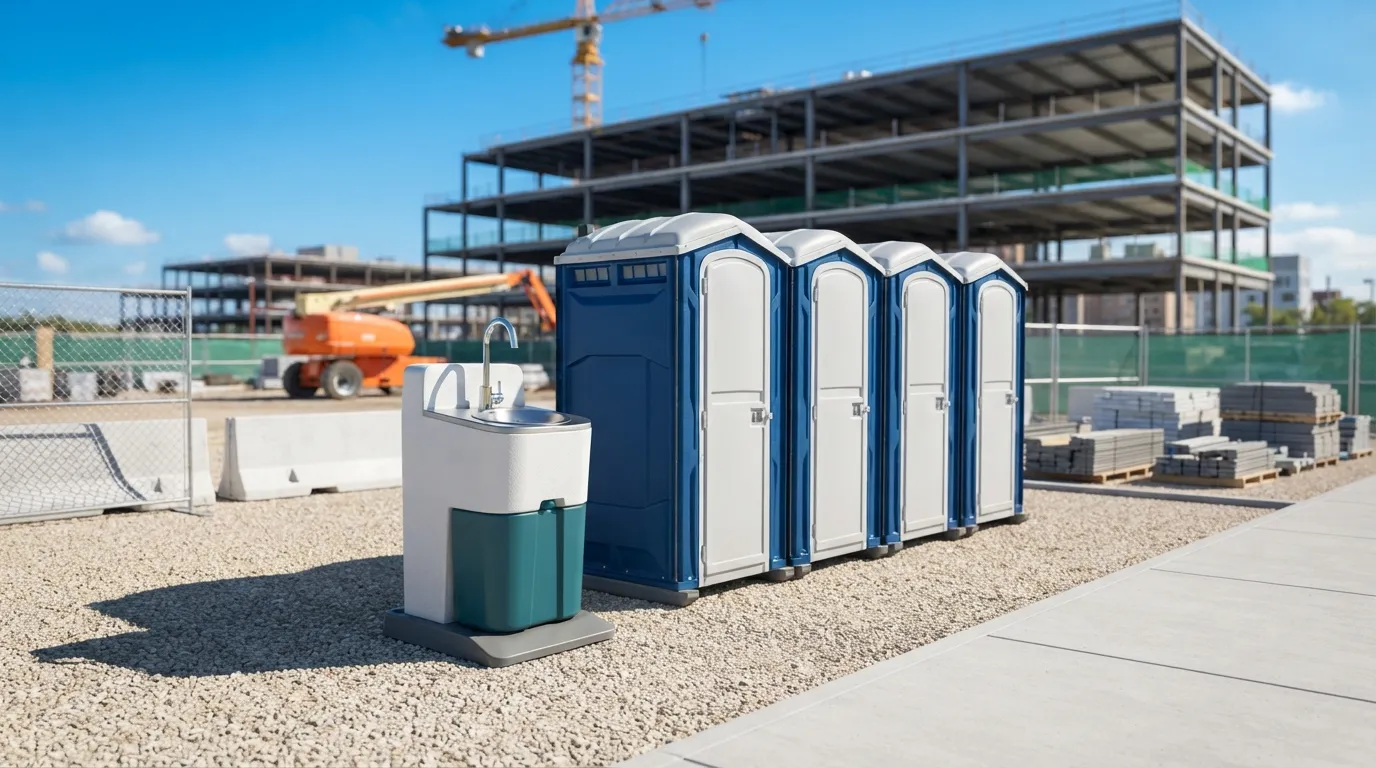
What does restroom placement look like on race day?
Placement follows the runner flow, not the easiest curb to reach. Units go at the start corral, every 1.5 to 2 miles on the loop, and in force at the finish chute where the field bottlenecks. A route that passes near San Miguel, 2.7 miles south, or extends toward Pleasant Hill, 5.7 miles northwest, needs units accessible from a service road, since a roll-off delivery or restroom swap needs about 60 feet of straight clearance behind the truck. We check our porta potty placement guide logic against your actual course map, not a generic grid. ADA Standards section 403.5.1 sets a 36 inch minimum clear width for the accessible route to each unit, and section 405.2 caps ramp slope at 1:12 where the ground isn't level, both of which matter on grass fields and gravel lots common to race staging areas. Add a handwashing station rental or two near food and water stations, since 29 CFR 1910.141(d)2 requires soap and towels, not sanitizer alone, at any washing facility you provide. Runners heading toward Lafayette, 5.8 miles west, or a course finishing near Danville, 10.8 miles southeast, still fall under the same Walnut Creek service window, and we coordinate delivery and pickup around your permit hours rather than a fixed clock.
Pricing for race-day restroom packages
| unit | duration | low | typical | high |
|---|---|---|---|---|
| standard | event | 200 | 400 | 800 |
| ada | day | 200 | 230 | 400 |
| trailer | event | 2499 | 3500 | 3899 |
| delivery_fee | day | 100 | 150 | 500 |
Check the full porta potty rental cost breakdown or the restroom trailer rental cost page if you're comparing a trailer against a standard bank for a large field.
How far in advance should we book race restrooms?
Book as soon as your course and headcount are set, ideally 60 to 90 days out for a permitted race. Placement in the public right of way needs confirming with the city, so lock your route map first. Large fields compete for trailer inventory during peak race season.
Do you service units during a multi-hour race?
Yes, for longer events we schedule a mid-event check on high-traffic units like the start corral and finish chute. ANSI/PSAI Z4.3 sets a baseline of one service visit per week for normal use, but race day volume calls for a tighter interval than that standard.
Can we get accessible restrooms at every checkpoint?
Yes. ADA Standards section 213.2 requires at least one accessible unit per cluster, never fewer than one, so every checkpoint bank includes an ADA accessible porta potty sized for the required turning space.
What if our race route crosses city lines?
Walnut Creek Porta Pros delivers across the routes we've measured, including courses stretching toward Shell Ridge, San Miguel, Pleasant Hill, Lafayette and Danville. Check our service areas page and we'll confirm coverage for your specific loop.
Should we add handwashing stations near aid stations?
Yes, especially where volunteers handle food or drinks. A portable sink rental or fixed handwashing station rental keeps aid stations compliant and keeps lines moving faster than a single shared unit.
Next step
Get a delivery date
Tell us the address, the dates and the headcount. We size the order and confirm the route.