
How Do Porta Potties Work?
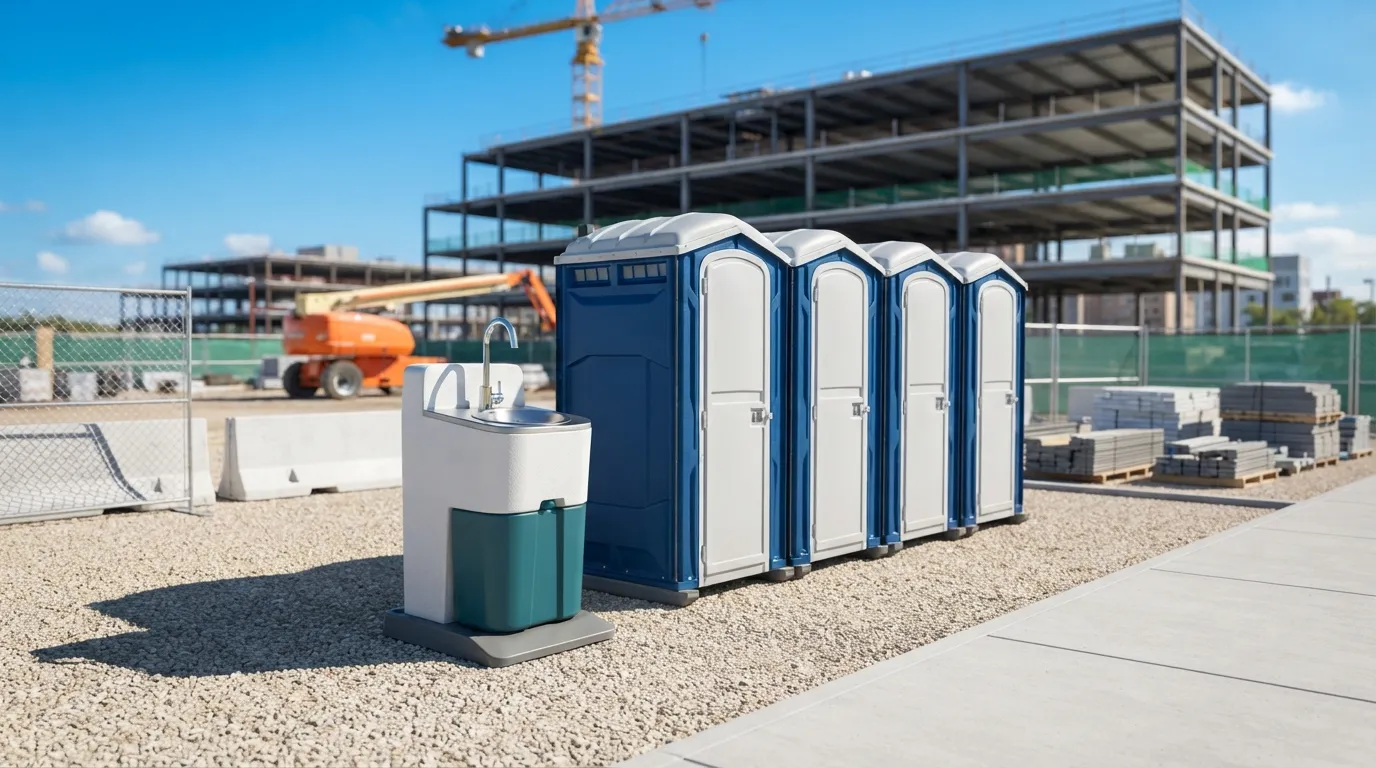
The unit is simpler than people expect. Waste drops into the 60 to 70 gallon holding tank, a chemical treatment breaks down solids and knocks down odor, and a vent stack carries gas up and out instead of into the stall. A standard standard porta potty rental footprint runs about 44 by 48 inches on the ground and stands roughly 92 inches tall, so it fits on a driveway, a job site pad, or a strip along a fence line. There's no flush, no faucet, no plumbing hookup. That's the whole point: it works anywhere a truck can reach it. A construction worker running to a porta potty on a Walnut Creek job site doesn't wait on a water line. Toilet paper sits in a small dispenser, hand sanitizer usually rides on the wall, and the service tech swaps out chemical and pumps the tank on the truck's next pass. If you're comparing this to a portable toilet rental with a sink built in, that's a step up in features but the tank-and-chemical core is the same.
How Does Portable Sink Work?
A portable sink rental runs on two separate tanks: fresh water pressurized by a foot pump or small battery pump, and a gray water tank underneath that catches the runoff. Soap and a paper towel dispenser mount on top, satisfying the intent behind 29 CFR 1910.141(d)(2), which requires soap and a towel or drying device at handwashing stations, not sanitizer alone. A handwashing station rental works the same way at larger scale, often with multiple basins feeding one gray water tank. These units get parked near food service, near construction site services crews, or paired with restrooms at events. The fresh tank gets refilled and the gray tank pumped on the same visit as your toilet service, so there's no separate scheduling headache. If your crew is applying paints, coatings or solvents, that's when OSHA 1926.51(f)(1) washing requirements actually apply, and a sink on site covers that obligation directly.
How Do Flushable Porta Potties Work?
A deluxe flushable porta potty adds a small fresh water reservoir and a foot-pump or hand-pump flush that rinses the bowl into the holding tank below, so it feels closer to a home bathroom. The tank is still self-contained, just like a standard unit, but the rinse cuts down on buildup and smell between services. These run more than a standard unit and fit weddings, backyard renovations, or any job where guests expect something nicer than a basic box. Pair one with an ADA accessible porta potty if you're hosting a mixed crowd; ADA Standards section 213.2 requires at least one accessible unit in any cluster, and the accessible model needs the 60 inch turning circle specified in ADA Standards section 304.3.1. For camping trips, the same flush mechanic shows up in smaller RV-style cassette toilets, though most rental camping porta potties in Walnut Creek use the standard tank-and-chemical setup instead, since campground access roads don't always allow for pump-out service on a tight cycle.
What Chemicals Go In a Porta Potty?
The chemical is a blue or green deodorizing treatment that breaks down waste, controls bacterial odor, and keeps the tank from foaming during transport. Techs add it fresh at every service stop, whether that's a weekly job site rotation or a one-day event drop. Homeowners searching for portable toilet chemicals near me usually just need the rental company to handle it, since dosing depends on tank size and usage rate, not something you eyeball from a jug. This is different from what goes into a residential septic tank, which typically gets pumped every 3 to 5 years depending on tank size and household load, not treated with additive chemicals on a weekly basis. If your property in Walnut Creek is asking about septic tank cleaning chemicals for an actual in-ground system, that's a separate service entirely. Check septic pumping service or how often to pump a septic tank for that side of things, and septic tank warning signs if you're not sure which one you need.
Sites within reach of Walnut Creek get the same weekly rotation. Shell Ridge sits 2.2 miles northeast, San Miguel is 2.7 miles south, and Pleasant Hill is 5.7 miles northwest, all inside a standard service loop. Lafayette runs 5.8 miles west. For toilet counts on an active job, OSHA 1926.51(c) sets the ratio: one unit per 20 workers on crews of 20 or fewer, scaling up from there. Check how many porta potties do I need or the full OSHA portable toilet requirements guide before you order. For pricing across durations, see porta potty rental cost, porta potty rental per day, or monthly porta potty rental. Placement questions belong on porta potty placement guide, and winter users should check porta potty in winter.
Do porta potties smell?
Some smell, especially in heat or with infrequent service, but a properly chemical-treated tank on a weekly pump schedule controls most odor. Vent stacks pull gas upward and out. See do porta potties smell for what drives odor and how service frequency fixes it.
How often are porta potties cleaned?
Weekly is standard under ANSI/PSAI Z4.3 for typical usage, but high-traffic events or busy job sites often need two or three visits a week. Full details are on how often are porta potties cleaned.
Can I rent a porta potty for just one day?
Yes. Daily rentals exist for one-off jobs, home projects, and single-day events, and a standard unit typically runs in the range shown on porta potty rental per day. Weekly and monthly rates drop the per-day cost if you need longer coverage.
Are porta potties required on construction sites?
Yes, under OSHA 1926.51(c), which sets minimum toilet counts by crew size. Most Walnut Creek job sites order based on peak headcount, not average. Review construction site services for what a typical setup includes.
What is an ADA accessible porta potty?
It's a larger unit built to ADA Standards, including a 32 inch clear door opening under section 404.2.3 and a 60 inch turning circle under section 304.3.1. See ADA restroom requirements for the full spec list.
Next step
Get a delivery date
Tell us the address, the dates and the headcount. We size the order and confirm the route.